

What shipped, and why.
Every post here is about something that shipped in the Lobstack app or its API, or a claim of ours that turned out not to be true. For the line-by-line version, the changelog is the shorter read.
x402: bots that pay per request
A new x402 Payments Agent template and five skills: a bot finds a pay-per-call API, pays a few cents inside your rules, and shows the receipt.
A bot's browser you can watch, drive and replay
Every click lands with a ripple and a named step. Take Over hands you the whole page, and a bot stuck at a sign-in now stops and asks for you.
Workflows, and a dry run that says what it would have done
A routine can now have steps, each with its own bot, tools and approval. A dry run does the real look-ups and lists every write it would have made.
“I don't have access to the add_rows tool”
A bot kept the narrow tool list of a job that failed while planning, and handed the work back. The fix, and an audit that gave every feature its bot tools.
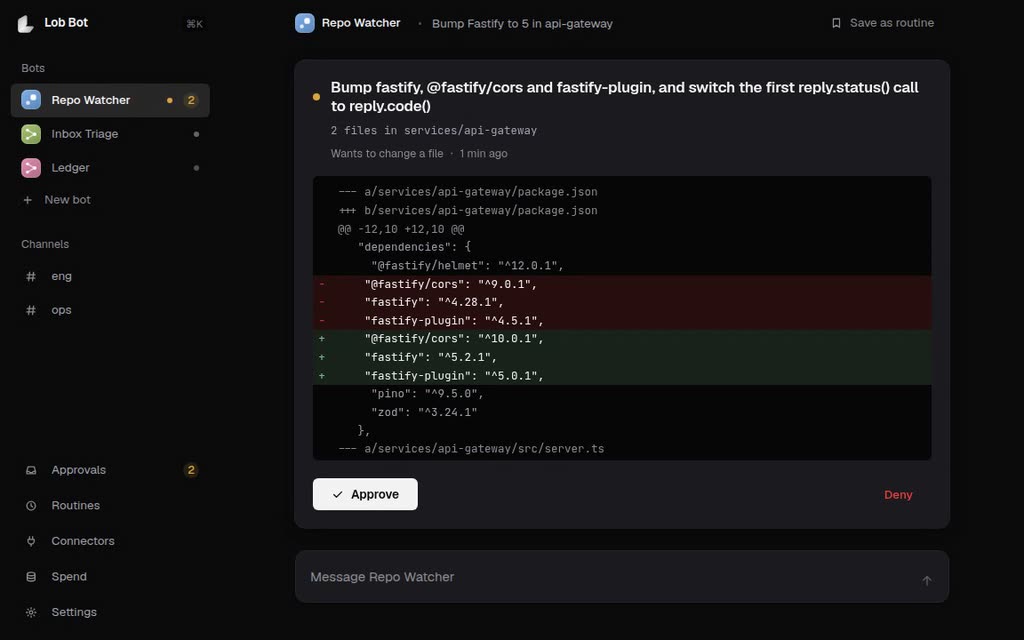
Approve from your phone, through a relay that cannot read the card
When a bot stops to ask, a phone you paired can answer. The card is sealed on your computer, and lobstack.ai carries it without being able to read it.
Lob Bot is now called Lobstack
The desktop app takes the company's name in 0.8.0. Your bots, threads, keys and settings stay exactly where they were.
Sign in with Lobstack, and $5 to start
From 0.7.0 a new install opens on one button. Your bots then run on the Lobstack API, and your first sign-in adds $5 of credit.
A terminal UI for the CLI, still with zero dependencies
The CLI opens a full-screen UI showing what each call cost as it happens, drawn by hand because a key-holding process should not pull a package tree.
An Agent Skill is not a connector
The Skills page listed 153 credentialed third-party integrations and called them skills. Not one of them was an Agent Skill.
Plans include dollars of model spend, not messages
A message is not a unit of cost. Every previous plan was underwater at its own advertised limit on any flagship model.
Comparison pages, with a build check that fails when a claim goes stale
Four gateways, one typed fact table, a first-party source on every claim, and a sixty-day shelf life the build enforces.
The price rides on the frame that carries the tokens
A streamed response cannot carry cost in a header, so the last chunk before [DONE] now carries it under x_lobstack, beside the usual usage object.
The Gateway returned 400 to every OpenAI request for three months
One sampling parameter the caller never asked for, roughly 1,395 consecutive failures, and three months of blaming the provider credentials.
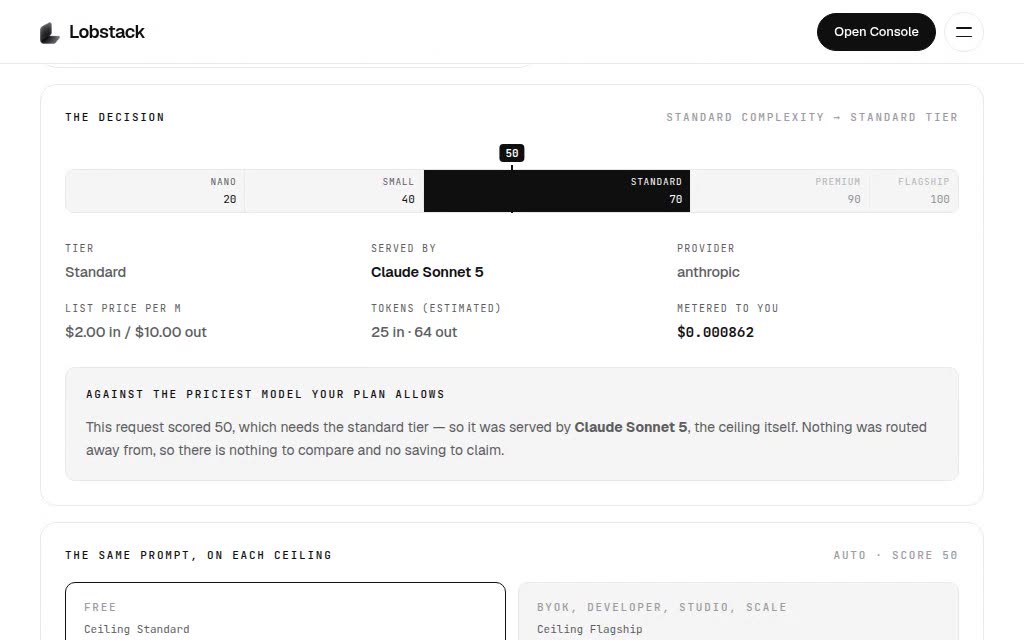
Every Gateway call comes back with a receipt
Cost used to be recomputed at read time from today's price list. It is now priced when the request is served and frozen on the ledger row.