

Lobstack vs Portkey
An MIT gateway plus a deep enterprise governance platform. Now Prisma AIRS AI Gateway, following the completed Palo Alto Networks acquisition.
Portkey is not trying to pick a model for you, and does not pretend to be. It computes cost accurately and keeps it in the dashboard — the response carries four headers and none of them is money.
Does it pick a model for you?
Rules you author, evaluated at the edge with no model in the path: conditional routing reads request metadata, request parameters and the URL path, with primitive-value operators. There is no automatic, complexity-based or semantic model selection anywhere in the product — a search across the whole documentation set returns nothing for any of it.
“All routing happens very fast on the gateway, on edge”
This is a design choice rather than a gap, and it has a real advantage: a routing decision with no classifier in front of it adds no latency and cannot be wrong in a way you did not write.
portkey.ai/docs/product/ai-gateway/conditional-routingLobstackYes — complexity tiers with a spend ceiling
Does it tell the caller why?
You wrote the rules, so there is nothing to explain. The response tells you which option was used by index.
“We send the following 4 response headers”portkey.ai/docs/api-reference/inference-api/response-schema
LobstackYes — on every response, no opt-in
Is the cost in the response?
No. Portkey returns exactly four response headers — trace id, retry attempt count, cache status, and last used option index. None carries a cost, and the open-source gateway's own source defines no cost header either. Cost is computed and accurate, and lives in the dashboard, the logs and an analytics API.
Reading what a call cost means a second, asynchronous query — and the Admin API that serves it is an Enterprise feature.
portkey.ai/docs/api-reference/inference-api/response-schemaLobstackYes — response headers
Does it price the model it did not choose?
No. The only savings Portkey reports are cache savings — a cache hit measured against calling the same model again, aggregated in a dashboard. Nothing anywhere prices a model the request did not use.
portkey.ai/docs/product/observability/analyticsLobstackYes — per request, on the response
What does it cost?
Free developer tier at 10,000 recorded logs a month with three-day retention; $49 a month for 100,000 with thirty-day retention; $9 per additional 100,000 up to three million; Enterprise custom above ten million. The gateway itself is MIT and self-hostable for nothing.
“$9/Month for Every 100K Up to 3M Requests”
Portkey's own pages disagree on what the quota meters — the tier card says recorded logs and says requests keep flowing past the cap, the comparison table on the same page labels the row “Requests per Month”.
portkey.ai/pricingLobstackNo cut of inference. Either a plan that includes dollars of model spend at our published rates, or BYOK — your provider keys, a flat monthly fee.
The part we had the least incentive to write.
The MIT gateway is genuinely permissive
Not BSL, not SSPL, no request cap, and the routing primitives — fallbacks, load balancing, conditional routing, retries, timeouts — are all in the open-source build. The licence-rug-pull worry does not apply here.
Speaking three API dialects to any provider
OpenAI Chat Completions, OpenAI Responses, or Anthropic Messages in, any provider out, across 1,600-plus models. That translation layer is what makes a migration cheap, and it is a lot of real engineering.
Enterprise governance is the actual product, and it is deep
SCIM, SSO, org and workspace hierarchy, granular RBAC, audit logs, budget and rate-limit policies scoped by provider and model, secrets referenced out of Vault or a cloud KMS, VPC and hybrid deployment, SOC 2 and ISO 27001 with BAAs. Years of unglamorous work we have not done.
MCP and agent governance shipped early
An MCP gateway went generally available in January 2026 with per-tool access control and OAuth, and an agent gateway followed in April. If the problem is governing what agents can reach, they were there first.
Cost accounting that respects your negotiated rates
Custom pricing overrides and discount multipliers, so tracked cost reflects what you actually pay a provider rather than list price. Enterprises with discounts care about this more than they care about routing.
Narrow, specific, and only what we checked.
Not capabilities Portkey lacks — places a documented behaviour stops short of what a caller needs.
Cost is never in the response
Verified twice — in the documented response schema and in the open-source gateway's own header constants. A caller cannot learn what a call cost without a second request to a different API.
That second request needs an Enterprise plan
The Admin API is Enterprise-gated, so programmatic cost access is not available on the $49 tier.
No counterfactual of any kind
Cache savings compare a model against itself. Nothing compares it against a model that was not used.
If you have read an older comparison of Portkey, these are the parts of it that are now wrong.
Acquired by Palo Alto Networks, and rebranded
portkey.aiThe acquisition has completed and the product is generally available as Prisma AIRS AI Gateway. For an enterprise buyer that de-risks the purchase; for a developer on the $49 tier it is a reasonable thing to ask about.
Virtual Keys retired for the Model Catalog
portkey.ai/docs/product/model-catalogAll organisations migrated in February 2026. Any guide still referencing Virtual Keys is out of date.
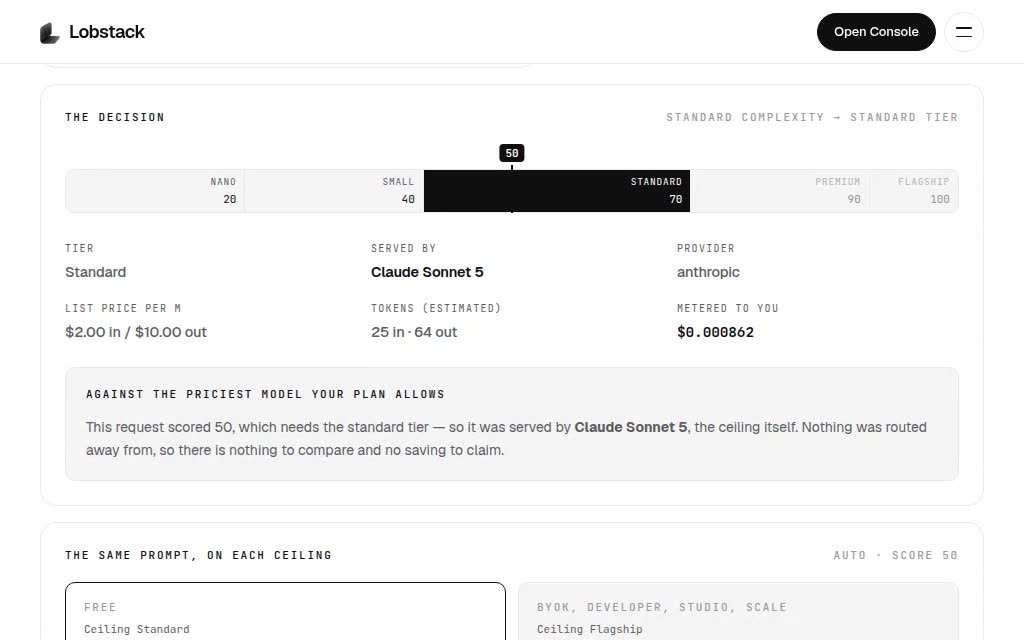
Lobstack returns the counterfactual on the request that caused it. The response carries what it cost, what tier answered, the complexity score behind that, whether it was routed — and what the baseline model would have charged for the same tokens.
Two limits, better read here than found after you integrate. On stream: true those figures move to the final frame, because our headers go out before the provider has counted a token. And a like-for-like saving needs a model you named — ask for auto and the baseline is the most expensive model your plan allows, the most flattering one available to us, so baseline_reason reads plan_ceiling and travels with every figure. The metering docs.
Every figure here was checked against Portkey’s own pages on 2026-09-10 and linked so you can check it too. Where we could not verify something either way, it says so rather than guessing.